Download the Full Experiment Log (PDF)
QUIETCONVERSION
Experiment Log
BScience
BSides SF · 2026
n=101 respondents | Materials cost: ~$3 | Outbound engagement rate: 100%

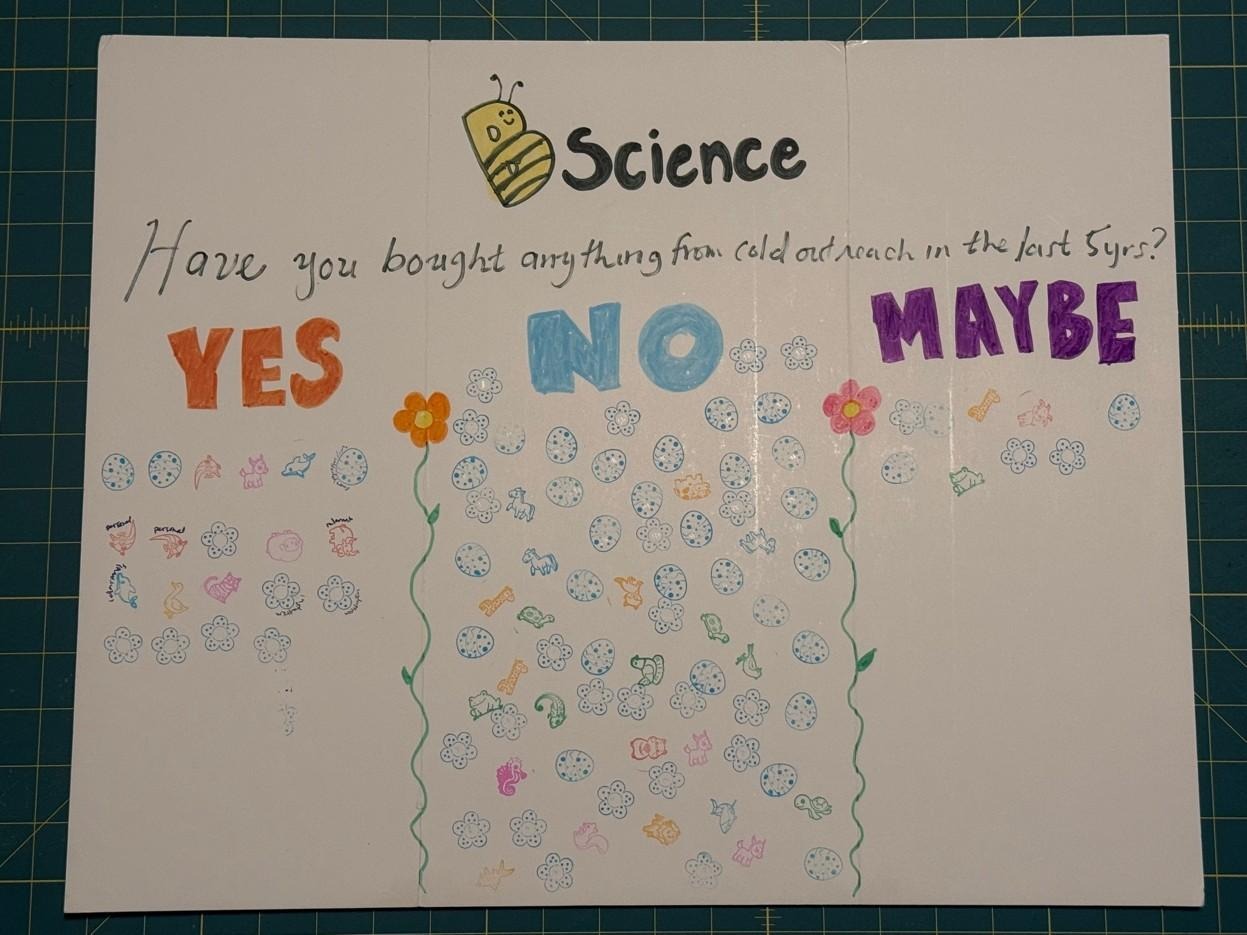
The BScience board after two days of data collection. The NO section speaks for itself. BSides SF 2026.
1. THE QUESTION
Primary question (Days 1–2):
Have you bought anything from cold outreach in the last 5 years?
Day 2 addition (respondent-suggested parallel track):
Have you sold anything from cold outreach in the last 5 years?
The Day 2 addition was unplanned. Midway through the second day, a respondent suggested tracking whether participants also sold via cold outreach. The researcher added it immediately, tracking responses on the back of the trifold flaps.
2. THE INSTRUMENT
Hand-drawn foam board, cut to half-sheet size and transformed into trifold for portability. The name BScience is a pun on BSides SF — the B drawn as a hand-lettered bumblebee with face and antenna. Three response sections: YES (left, orange block letters), NO (center, blue block letters, sized slightly larger because the researcher predicted it would receive the most stamps — correct), MAYBE (right, purple block letters). Sections divided by hand-drawn wavy green vines with leaves. The question written in cursive across the face of the board.
Response mechanism: two self-inking stamps borrowed from the researcher’s son’s stamp collection — an easter egg and a flower, both duplicates so he wouldn’t miss them. Participants could stamp themselves or have the researcher stamp on their behalf.
Unplanned addition: BSides was running a bingo game simultaneously. Several booths had animal stamps. Participants occasionally used those too. The final board contains flowers, easter eggs, and a small conference zoo — dolphins, giraffes, and others unidentified.
Day 2 parallel track: responses tracked on the back of the trifold flaps using the same stamp mechanism.
Total materials cost: ~$3. Foam board from a 3-pack. Stamps from a 5-year-old’s collection.
3. DESIGN CONSTRAINTS
| Constraint | Reason |
|---|---|
| No QR code / no digital | Removes friction. No phone required. Keeps the interaction physical and present. |
| Anonymous by design | No name, no badge scan, no identity attached to the stamp. Lower stakes = more honest responses. |
| Tactile response mechanism | Stamps are fast, satisfying, and memorable. Increases imprinting for both participant and researcher. |
| Speed of capture | Under 10 seconds to respond. Respects conference attention spans. |
| Cognitive load reduction | One question. Three options. That’s it. |
| Conversation-first | Genuine engagement established before the research ask, every time. No cold survey drops. |
| Portable instrument | Half-sheet foam board fits under one arm and doesn’t dominate the interaction. |
| Deliberately homemade aesthetic | Matched BSides culture intentionally. BSides is the scrappy, community, anti-corporate conference. A polished instrument would have created distance. The handmade bee and kid stamps created permission. |
4. WHAT I EXPECTED
The majority would say no. Cold outreach is widely criticized in cybersecurity circles and BSides skews practitioner-heavy — the people most likely to have strong opinions about being on the receiving end of it. I expected NO to dominate, YES to be a small minority, and MAYBE to capture the ambivalent middle.
I did not expect follow-up conversations to produce a structural finding. I thought the board data would be the story. It wasn’t.
5. WHAT HAPPENED
Primary question: Have you bought anything from cold outreach in the last 5 years?
| Response | n | % | Signal |
|---|---|---|---|
| Yes | 20 | 20% | Cold outreach did lead to a purchase — follow-up conversations reveal why |
| No | 72 | 71% | Majority have not bought from cold outreach in five years |
| Maybe | 9 | 9% | Uncertain — possibly indirect or timing-dependent |
| Total | 101 | 100% |
Day 2 parallel track: Have you sold anything from cold outreach in the last 5 years?
n=28 (remaining Day 2 interactions, unqualified by role — buyers and vendors mixed)
| Response | n | % | Signal |
|---|---|---|---|
| Yes | 14 | 50% | Half of Day 2 respondents sold via cold outreach |
| No | 12 | 43% | |
| Maybe | 2 | 7% | |
| Total | 28 | 100% |
The gap is immediate: roughly half of this sample has sold cold. Roughly 20% of the full sample has bought cold. Someone is wasting significant effort.
6. THE SURPRISE
The most significant finding did not come from the board. It came from follow-up conversations with the 20% who said yes.
When asked what made them respond to cold outreach, the answer was consistent: timing. They happened to be actively looking for that specific solution when the outreach arrived. The cold mechanic did not create the need or the interest — it arrived at the right moment.
This led to a deeper line of questioning about how purchasing decisions actually get made in cybersecurity. What emerged was a pattern the standard cold outreach model does not account for.
“I just buy whatever my engineer is bothering me about.”
— CEO, prominent security company, BSides SF 2026
Multiple engineers described the same pattern independently: they identify a tool because they have a specific need, test it themselves, advocate internally, and eventually get budget approved by a manager or CISO who trusts their judgment. The CISO does not buy cold. They buy warm — warmed by their own team.
The engineer, meanwhile, does not buy anything. They test, recommend, and advocate. They are the influence layer through which cold interest is converted into warm decisions at the executive level.
This finding — the Engineer Influence Layer — is now central to QuietConversion’s GTM research. It was not on the board. It was in the conversation.
7. WHAT THIS OPENS
Does deliberately targeting engineers as the influence layer outperform cold CISO outreach? This research opens the hypothesis but cannot yet test it.
If timing is the operative variable in cold outreach conversion — not the mechanic itself — what does that mean for how vendors should think about pipeline? Are they optimizing for volume when they should be optimizing for presence at the right moment?
The Day 2 sell-side data raises a separate question: if ~50% of practitioners sell cold and ~20% have bought cold, where does the gap live? Role, industry, seniority, or something else?
BSides respondents were not segmented by role. Future iterations should add role identification from the start.
8. LIMITATIONS
Single researcher. n=101 is sufficient for directional findings but not statistical generalization.
Respondents were not segmented by role. The buying question was answered by a mixed population of buyers, vendors, and practitioners. Role segmentation would strengthen future iterations.
100% outbound engagement rate likely reflects a researcher effect — the researcher’s approachability and conversation-first methodology reduced friction in ways that may not generalize to all researchers.
The Day 2 parallel track (n=28) was unplanned and mid-experiment. It should be treated as directional only.
Physical board counts were tallied manually in field conditions. Final counts reflect best available data.
About This Research
QuietConversion studies trust signals in cybersecurity go-to-market. This experiment is part of ongoing field research into how trust develops, breaks, and compounds across the full GTM stack — booth, website, drip, and beyond — with a focus on early and mid-stage companies in high-trust verticals.
Strategy matters.
But trust moves markets.
With heart,
— Rhea Lynn Mascarinas
Founder & Lead Researcher | QuietConversion
© 2026 QuietConversion. All Rights Reserved.
Want the data? Download the full formatted experiment log including all tables and methodology notes here: Download PDF